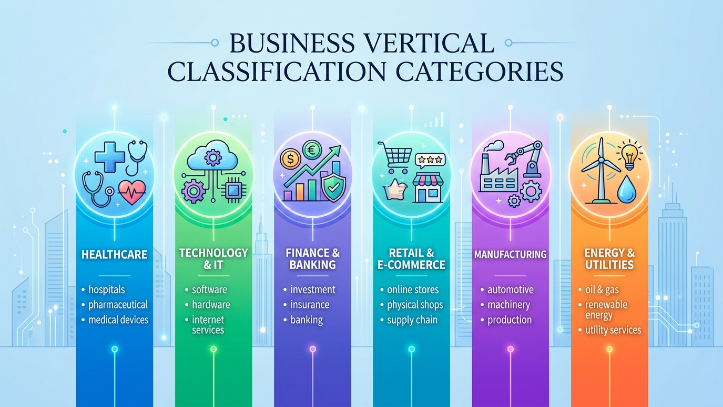
In the complex architecture of modern commerce, the ability to categorize a business according to its operational focus is not merely an academic exercise; it is a fundamental requirement for strategic positioning, resource allocation, and market penetration. Business vertical classification refers to the systematic grouping of companies based on the specific industry, niche, or market segment they serve. Unlike horizontal markets, which provide broad services across multiple sectors, vertical markets focus on a single specialized area, catering to a specific set of needs, regulatory requirements, and consumer behaviors.
To navigate today’s hyper-competitive landscape, organizations must understand the nuances of vertical classification. This understanding allows leaders to tailor their product development, marketing messaging, and supply chain logistics to the idiosyncratic demands of their chosen field.
The Core Dichotomy: Vertical vs. Horizontal Markets
Before diving into specific categories, it is vital to distinguish between vertical and horizontal classifications. A horizontal business provides products or services that are useful across various industries. A classic example is an accounting software firm like QuickBooks or a cloud storage provider like Dropbox; their services are equally applicable to a construction company, a law firm, or a bakery.
Conversely, a vertical business operates within a specific industry or “vertical.” They solve problems unique to that industry. For instance, a software company that builds “Electronic Health Record” (EHR) systems is strictly in the healthcare vertical. They do not seek to sell to retail stores or manufacturing plants because their product is engineered for the specific regulatory and operational workflows of medical professionals.
Primary Business Vertical Classification Categories
Business verticals are generally categorized into several broad sectors, each containing thousands of sub-niches. Understanding these primary categories provides the baseline for market analysis.
1. Healthcare and Life Sciences
The healthcare vertical is one of the most regulated and capital-intensive sectors. Classification within this vertical often breaks down into:
- Providers: Hospitals, clinics, and private practices.
- Payors: Insurance companies and government health agencies.
- Pharmaceuticals and Biotech: Companies focused on drug discovery and clinical trials.
- Medical Devices: Manufacturers of surgical tools, imaging machines, and wearables.
The hallmark of this vertical is the “triple constraint” of patient outcomes, regulatory compliance (such as HIPAA in the US), and cost management.
2. Financial Services and Fintech
Often referred to as the “BFSI” sector (Banking, Financial Services, and Insurance), this vertical is the backbone of the global economy. It is categorized by:
- Retail Banking: Consumer-facing services like savings accounts and mortgages.
- Investment Banking: Capital raising and mergers and acquisitions.
- Insurtech: The modernization of insurance through data analytics and AI.
- Wealth Management: High-net-worth portfolio management.
Success in this vertical depends heavily on trust, security, and the ability to process massive amounts of transactional data in real-time.
3. Retail and E-commerce
The retail vertical has undergone a massive transformation due to digital integration. It is classified into:
- Brick-and-Mortar: Traditional physical storefronts.
- Direct-to-Consumer (DTC): Brands that sell directly to users via online platforms, bypassing third-party retailers.
- B2B E-commerce: Platforms facilitating wholesale trade between businesses.
- Marketplaces: Aggregators like Amazon or Etsy that host multiple sellers.
4. Manufacturing and Industrial
This vertical focuses on the production of physical goods. It is often segmented by the nature of the output:
- Discrete Manufacturing: Producing distinct items (cars, furniture, smartphones).
- Process Manufacturing: Producing goods via formulas or recipes (chemicals, beverages, refined oil).
- Heavy Industry: Large-scale infrastructure and machinery.
5. Technology, Media, and Telecommunications (TMT)
This is perhaps the fastest-evolving vertical, encompassing:
- SaaS (Software as a Service): Cloud-based delivery models.
- Digital Media: Content creation, streaming services, and social media.
- Hardware: Semiconductors and consumer electronics.
- Telecom: Providers of internet and cellular connectivity.
The Significance of Vertical Classification in Strategy
Why do businesses obsess over these classifications? The answer lies in the efficiency of specialization.
Targeted Marketing and Sales
When a business identifies as part of a specific vertical, its marketing becomes significantly more potent. Instead of using generic language, a “Vertical SaaS” provider for the legal industry can use terms like “discovery,” “litigation support,” and “billing increments.” This resonates with the customer’s pain points, leading to higher conversion rates and lower customer acquisition costs (CAC).
Regulatory Navigation
Each vertical has its own “language” of laws. A manufacturing company must navigate OSHA and environmental regulations, while a fintech firm must deal with AML (Anti-Money Laundering) and KYC (Know Your Customer) protocols. Categorization allows businesses to build compliance frameworks that are specific to their risks, preventing costly legal battles.
Product-Market Fit
Specialization allows for “deep features.” A horizontal project management tool might have a generic calendar. However, a project management tool specifically classified for the “Construction Vertical” will include features for blueprint viewing, subcontractor lien waivers, and site inspection logs. This depth makes the product “sticky” and harder for competitors to displace.
The Rise of Micro-Verticals
As markets become saturated, we are seeing the emergence of “micro-verticals.” This is a classification that goes even deeper than a standard vertical. For example, instead of just “Retail,” a company might focus on “High-End Organic Skincare E-commerce.”
Micro-verticals allow small to medium enterprises (SMEs) to dominate a small pond rather than struggling in a large ocean. By becoming the absolute authority in a hyper-specific category, these businesses can command premium pricing and enjoy intense brand loyalty.
Challenges in Vertical Classification
Despite the benefits, classification is not always permanent or easy.
- Vertical Blurring: With the rise of “Everything as a Service,” lines are blurring. Is Tesla a manufacturing company (Automotive Vertical) or a technology company (TMT Vertical)?
- Expansion Risks: Moving from one vertical to another (e.g., a healthcare tech company trying to enter the education market) often fails because the “domain expertise” does not transfer.
- Data Silos: Categorizing too strictly can lead to internal silos where information isn’t shared across different business units, stifling innovation.
Future Trends: AI and Automated Classification
The future of business vertical classification lies in Big Data. AI algorithms can now analyze millions of data points—from SEC filings to website metadata—to categorize businesses more accurately than manual tags. This “dynamic classification” allows investors and partners to identify emerging trends and “hidden” verticals before they become mainstream.
Furthermore, as the “circular economy” grows, we may see new verticals emerging around sustainability and carbon credit trading, which will require entirely new classification standards and regulatory bodies.
FAQs
Q: What is the difference between a business vertical and a business niche?
A: A vertical is a broad industry category (e.g., Healthcare), while a niche is a specific segment within that vertical (e.g., Pediatric Telehealth for rural areas).
Q: Can a company belong to multiple verticals?
A: Yes, large conglomerates often operate across multiple verticals. However, for startups and SMEs, focusing on a single vertical is usually recommended to establish market share.
Q: Why is vertical classification important for investors?
A: Investors use these categories to compare “apples to apples.” They look at industry-specific benchmarks (like EBITDA margins in manufacturing vs. SaaS) to determine if a company is performing well relative to its peers.
Q: How does a horizontal company “verticalize”?
A: A horizontal company can verticalize by creating industry-specific versions of its product, hiring industry experts for its sales team, and attending sector-specific trade shows.
Q: Is “Vertical Integration” the same as “Business Verticals”?
A: No. Business verticals refer to the industry category. Vertical integration is a strategy where a company owns multiple stages of its production or distribution chain (e.g., a clothing brand that owns the cotton farm and the retail store).
